Squeezing Experiment
We have measured twice below threshold regime.
Contents
- 1 All data table
- 2 7th of November
- 3 8th of November
- 4 9th of November
- 5 12th of November
- 6 14th of November
- 7 15th of November
- 8 16th of November
- 9 18th of November
- 10 Delayed squeezing
- 10.1 17-19th of December
- 10.2 20 of December
- 10.3 21st of December
- 10.4 24-25th of December
- 10.5 27th of December
- 10.6 28th of December
- 10.7 1st of January
- 10.8 2d of January
- 10.9 3d of January
- 10.10 4th of December
- 10.11 7th of January
- 10.12 8th of January
- 10.13 9th of January
- 10.14 10th of January
- 10.15 11th of January
- 11 January-continuous
- 12 February
- 13 March-pulsed
All data table
| Date | Trial | Power MBR side [uW] | Power Toptica side [uW] | Visibility | Alignment | YL lock | Squeezing | Lens cavity frequency | MBR detuning | Comments |
|---|---|---|---|---|---|---|---|---|---|---|
| 7.11 | 1 | 10 | 140 | 90% | Off | 70.85 | 1-3 dB | 7895 | ||
| 8.11 | 1 | 10 | 140 | 90% | Off | 7895 | ||||
| 9.11 | 1 | 10 | 140 | 90% | Off | 70.7; 70.8; 70.88 | 7895 | |||
| 2 | 10 | 140 | 90% | On | 70.88; 70.8; 70.7 | 7890 | ||||
| 14.11 | ? | 100 | 90% | Off | 70.7; | 1-2dB | 7890 | 20 | Sets with 8 & 10mW LO power | |
| 16.11 | 1 | ? | ? | 90% | Off | 70.7; | 7890 | 20 | Toptica was unstable | |
| 2 | 10 | 50 | ? low? | Off | 70.7; | 2 dB | 7890-7891 | 20 | Fast&slow scan, unbalanced BCkGND | |
| 3 | 43 | 160 | 90% | Off | 70.7; | 7891 | 30 | Fast&slow, scope cut toptica | ||
| 4 | 40 | 140 | 90% | Off | 70.7; | 7891 | 30 | Fast&slow |
7th of November
- We aligned pumps off resonance with the main cavity.
- Used 140uW of Toptica and 10uW of MBR.
- We installed HWP before the main cavity to reduce back reflection from 800 to 100 nW (leakage).
- The phase between two pumps is scanned by a slightly different AOM frequencies.
- visibilities 90% measured with homodyne detector. The positive and negative channels differ a bit.
- The MBR is red detuned by 20-40 MHz
- HWP after the cavity is set to 5% loss of toptica
The squeezing ranges from 1 dB to 3 dB.
8th of November
- We made a new pulse sequence to take background at each run. Files are in the folder time_calibr_8_11. The timing was 50us nothing, 1400 pumps, 1000 background
♠ We see different background levels if we switch off coils compared to, switching off MBR pump. If we switch off coils the level is always higher.
♠ We saw increase of contrast, when we shifted YL lock frequency 70.88-> 70.65-70.7
♠ Unexpained behaviour, when we change MBR power, antisqueezing increases with a decrease of squeezing
9th of November
♣ We measured gain of both homodynes.
♣ We calculated noise jitter
- We took data both in resonance and off resonance. We had to adjust lens cavity frequency to 6895 MHz for off resonance and 6890 MHz for on resonance
12th of November
♣ We took leakage spectra (files are here: C:\Users\Eugene\Dropbox\DLCZ_2018\November-2018-phase-noise\12November) or prep-lab computer: C:\Users\mylab\Downloads\12November, 50-100-200 MHz LP filters are present:
- only LO; LO+ toptica unlocked; LO+ toptica locked. Toptica pwr 115 mW
- toptica pwr 100; 90; 80
- 70;60;50
- 40;30;0
14th of November
1-2 dB squeezing, Toptica pwr 100 uW
15th of November
We have noticed that TMSV could be generated both in homo and heterodyne regimes.
16th of November
We took 2 sets of worth data, on average we have 2 dB squeezing. possible ways to get more,
- account for losses,
- increase detuning which leads to higher Toptica powers.
- Decrease leakage.
We have noticed two regimes: high sq and antisq, and low.
18th of November
Plan is to take data for different currents through getters,
- check who lifts the MBR homodyne level
- measure clearance
♥ we found that MBR Homodyne signal is not balanced together with LO

MBR homodyne leakage
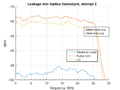
Toptica homodyne leakage


Delayed squeezing
17-19th of December
- we cannot overlap to pumps in time domain, as they will generate continuous 4WM
- we send MBR pump into toptica homodyne, toptica pump into MBR homodyne to have timing
- in continuous regime we cannot mismatch two signals by more than 20 points => 40 ns, to have scanning
- rising time is ~70 ns
20 of December
Probably scanning in 91st sample???
21st of December
We used 500ns/500 ns pulses.
- we have spikes on Toptica HD, due to MBR pump
- We generate narrow spectral width pulses, duration is around 300 ns
- Generation "above threshold", even knowing that in continuous regime is below threshold.
- Often continuous generation in one channel, with nothing in other.
- we don't see scanning in standard deviation
24-25th of December
We observed short pulses of MBR on the rising edge of the pulse, they have high frequency (20 MHZ). Probably the signal is on 59 MHz, but transformed due to nonlinearity of the filter. We think it is Reileigh.
- For long pulses 1-3 um, we have generation on the edges of them (precursor).
- After we switch off only the MBR laser we see the dead time, but keep toptica pump pulsing. After this generation slowly increases, more in toptica channel, less in MBR.
- We tested if yellow laser, brings the population back, although if we close MBR pump or Toptica
- We had reasonable response for 200 ns pulses, we have one pulse in each channel. These pulses look correlated. On maximum we have two pulses in Toptica channel.
♠ Why the population decreases that fast, no other pulses.
♠ The population on F=2, we have to prepare with 50us repumper pulse
We checked it making the prepumping Toptica pulse and monitoring, whether the first pulsein toptica channel is higher or the same.
♠ We had huge leakage of MBR pump into toptica HD, on the edges. The same as before? 5 mV Is it due to the filter or the power is higher in that moment?
27th of December
- 20-40 ns time that photon spends in the cavity
- We have both zero order leakage and 1st order leakage.
a) We estimate to have 30-100 nW of zero order after the fiber, which decreases to <2nW before the cavity (50% and 10% transmission). The zero order wouldn't work as a seed as it has orthogonal polarization to our toptica signal photon.
b) The first order leakage is 0.1% of the energy in the "ON" regime. We send ~100uW of toptica power (before the cavity), decreases to 100 nW.
- we added a pulse of repumper, after each pair of pumps. And it helped to restore high signals in toptica channel. Almost of the same amplitude as the first pulse in previous days.
- the MBR signal is always lost! Must be absorbed by atoms?!
- Does the size of two modes matter? Is it possible that MBR pump addresses more atoms than toptica can pump back due to the size?
- Why toptica pump is inefficient, we need a long repumper pulse to restore the populatiopn on F=2 level.
- Why we don't have the first pulse to repeat, if we switch off toptica pump, but keep repumper?
- If we run simultaneous pulses of different durations 100, 200, 350, 500 ns. Then we see that generation requires some time to set (to increase to maximum level). 5-10us, 2-3 pulses of pumping. Although for the shortest pulses it never gets to stable generation. Oscillations are generated only in the range of toptica's powers, If it is too high only the first pulse is present. Time codes:
[18.45 -> 500ns ]; [18.46 -> 350ns ]; [18.47 -> 200ns ]; [18.48 -> 100ns ]
- Different detunings gives different regimes:
| Detining, MHz | 0 | 10 | 20 | 30 | 40 | 50 |
|---|---|---|---|---|---|---|
| Only MBR, many pulses, no toptica | only the first pulse everywhere | only the first pulse everywhere | a few pulse in toptica | Strong pulses in toptica, no MBR | Strong pulses in toptica, no MBR |
28th of December
We tried 5 different regimes with the same pulse duration, all pumps are delayed:
| Program, # | Purpose | Pulse duration | Repumper range | MBR spectroscopy | Delay bw cool and first pump | Delay bw two pairs of pulses | Delay bw two pumps | Time code |
|---|---|---|---|---|---|---|---|---|
| 9 | Regular test program | 200 ns | 600-800 ns | No MBR | 1-2 us | 1 us | 70 ns | 14.47 |
| 14 | We delay the first pair of pulses from the cooling off time, check if atoms disperse in 5 us | 200 ns | 600-800 ns | No MBR | 5 us | 1 us | 70 ns | 14.51 |
| 15 | We spread two pairs of pulses away from each other, to make sure that we do not have any stored excitation, when the second pair arrives | 200 ns | 600-800 ns | No MBR | 1-2 us | > 20 us | 100 ns | 14.57 |
| 16 | We add one more repumping beam. MBR spectroscopy, it is in resonance with transition | 200 ns | 1-1.3us | 480 ns, starts with repumper | 150 ns | 15.02 | ||
| 17 | We move two pumping pulses further away from each other. We don't want any simultaneous generation, if the signal is delayed in the cavity, while the second pump arrives. | 200 ns | 1.2 us | 480 ns, starts with repumper | 130-240 ns, edge of repumper to MBR pump | 2 us | 220 ns | 15.07 |
- Why MBR signal is much weaker than toptica signal? We have two explanations:
 a) We do not effectively restore signal, toptica pump is too low. If we increase it we have large leakage
 b) Signal is absorbed/ scattered before it can leave the cavity.
- additional MBR pump increases MBR signal and damps toptica signal
- we want to try longer pulses and start working below threshold
1st of January
We saw correlations, if only we sent additional MBR pump. Its frequency is set to 79 MHz, P=3uW. We used program #18.
2d of January
We used program #18. We keep losing MBR photon. Possible reasons:
a) coherence is lost
b) MBR photon is off resonance with cavity
c) MBR photon is lost, scattered...
d) not enough toptica power
- We tried to increase toptica power up to 1 mW. If we increase power keeping the MBR power, both signals stay the same. If we increase MBR to 50 uW, we start seeing simultaneous generation of 4WM.
- We still have the same behaviour: if MBR is in resonance, we see MBR signal. If we detune MBR signal disappears, we see only toptica.
3d of January
We did a few tests:
- When we send only Toptica pump and MBR spectroscopy, we see the signal in MBR channel. We use regular #18 program.
- Using the same #18 program we changed the central frequency of the lens cavity, it didn't change a signal in MBR channel. It always act as an offset. Is it Toptica or other high power signal on the wrong frequency.
- We used a new pulse sequence #22 to generate at first regular continuous 4WM and after switch to delayed pulses. Atoms are still initially polarized by 30us of repumper. We observed that continuous generation can be followed by the signal in both channels, if we detune our cavity by ~34MHz, we changed YL lock frequency 71.8 -> 71.45 MHz. Power P(MBR)=50-100uW, P(top)=?
4th of December
We saw generation above the threshold in the correct time windows. Generation of 4WM in a constant regime is suppressed. We have similar powers of signals, we work with 20-40MHz detuning. We used regular 71.8 MHz for cavity lock.
P(MBR) = 70-80 uW [140-160 degrees]; P(top) = 51 uW [74 degrees]
We obtain two regimes:
- Analogous to result obtained in the presence of an extra MBR pump. Powers more MBR pump than toptica pump. In the last trials we had powers mentioned above. There are no oscillations in signals. Best examples: 71, 74, 82, 84, 85. We see toptica signal to have scanning.
- Samples 1-10, We have correlations in both channels somewhat correlated. We have only strong first pulse during continuous stage. Higher toptica power, oscillations in both signals. If signals are somewhat balanced we have different STD sum and difference.
7th of January
We tested the single pulse regime. We don't seem to have an MBR photon.
1) population on F=2, we leave repumper for extra 30 us,
2) population on F=1, we leave cooling for extra 10 us,
8th of January
We switched back to continuous squeezing, we had to adjust frequency of YL to 71.55 MHz to see the "above the threshold" regime. We saw squeezing, recorded both slow and fast scanning. We tested with different cooling sequencies, all give similar results:
a) almost simultaneously
b) 10 us of cooling (contrast is a bit higher?)
c) 30 us of repumper
We don't know how to improve the continuous result, so we decided to search for the MBR photon.
We saw maximum toptica signal, when we are detuned by ~60 MHz. If we detune further-> less signal. We checkeed that YL doesn't generate any signal, we manually with an offset knob set the cavity length. As well the lens cavity lock doesn't effect the result, we can manually adjust toptica frequency to see it. We haven't seen MBR signal if manually scan the cavity length through and near resonance.
9th of January
- We tested Xianxin's idea, what if we have a stationary light pulse. We switched MBR to come from the fiber, it made no difference we still had signal in this transition.
- We tested detection path difference by switching the wavelengths of both lasers. We still only see photon on transition F=1 <-> F'=2
10th of January
- We checked cooperativity and we have it for both transitions. We made sure that cavity is in resonance with a corresponding probe pump.
- We made sure that this is not a coherence created between two ground levels during cooling stage.) We saw signal at high delays 1-2 ms, almost no signal at 5 ms.
- We have found that repumper is not switched off fully, approx 700 uW out of 17 mW still goes during an experiment stage. We fixed it by modifying a program pdh11.ino. Due to this and longer time of cooling 30 us, we see significant signal on F=2 <-> F'=2 transition.
- Both pulsed and continuous 4WM regimes changed, now they depend differently on both pumps powers. It is is much easier to go above the threshold.
11th of January
Plan:
- Check balancing above the threshold
- Balance signals in a below threshold regime
- record power dependence
What we did:
- The first set of data in continuous. We switch off both cool and repump simultaneously. We have maximum contrast at 71.6 (closer in resonance with MBR pump). We noticed that both signals increase if we detune until 30-40 MHz, where they reach plato.
- Noncollinear scheme, toptica is send through the side. We tend to have more MBR signal. Although the leakage level in MBR Homodyne is the same, the cavity is very well aligned.
Outro:
We had a big level of leakage( 2db), which doesn't allow us to freely talk about squeezing level.
January-continuous
13 of January
Plan:
- Try to decrease leakage
- Take slow scanning data
- Leakage hystogram
14 of January
- We used new alignment scheme: firstly align homodynes using ideally aligned cavity, after mismatch pumps. Leakage was on a scale of 0.5-0.8 dB. Detuning 50-60 MHz. Slow scanning best shots are #853, #829.
- Slow scanning gives consistently low values (i) 3.4dB/-0.6dB(true vacuum), (ii) 3dB/-1dB(backGND). For such values (ii), we have to have losses in each channel of 73% and squeezing parameter ε=0.65. It gives 6.7 dB of squeezing accounted for losses. And in (i) case η =85%, ε = 0.8; squeezing 9.5 dB. η gives losses in each channel.
- L's paper on squeezing gives interestengly comparable values. The squeezing achieved on the output of the crystal: 8dB/-3dB, η =0.4; ε =0.8. The light they send into the cell 5.1dB/1.2dB, η =0.7; ε =0.8.
- We fitted noise data with normal distribution.
- We tested pulsed regime. We have signal after ~300 ns. Although the levels are different 5-10 times.
- Cavity mode new understanding
Conclusions:
♥ our losses are too high.
♥ Pairing of photons is low, low finesse? UV lamp?
15th of January
Plan:
- mode match two pumps
- characterize storage time
- take shot noise again, non-Gaussian distribution in previous data
Slow scanning
Best shots: 67 70(6.3/-1.6) 72 79, 94. Fast scanning: 200
Leakage analysis
We analyze the homodyne hystogram (number of points with certain voltage versus the voltage) with only local oscillator present. We tried to simulate this effect with randomly generated data and we don't see such a shape changing.
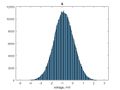
Clearly normal distribution, 2mV scale
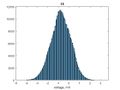
Deformed distribution due to lack of resolution, 10mV scale


Conclusions
We have to use higher resolution on the oscilloscope, so the slow scanning reaches same levels as a fast scanning
16th of January
We looked at the signal at the different angles of two pumps. Only ideally collinear case gives more Toptica. Usually it is more MBR signal (twice more), they become balanced at only very large detunings >60MHz.
17th of January
MBR pump focuses tighter in the atomic cloud. Idea was to expand both modes simultaneously. Good data on efficiency conversion. Where is leakage? Should we consider twin-beam squeezing measurement?
Leakage thoughts
- try to compare signals SN+Leakage+|α > and SN+|α >
- check linearity of detector in the presence of the leakage
- does background level ever decrease in the presence of leakage?
18th of January
MBR homodyne
We realigned the mode through the fiber. We can see that either leakage or LO is balanced on a homodyne detector. Mode of LO didn't look too good: oval in the near field, strange in the far field.
21st of January
New squeezing data, after alignment of MBR homodyne. The beam wasn't focused in the proper place, we resend the LO through a fiber. Interference is 90-95% , different for different channel.
22-23d of January
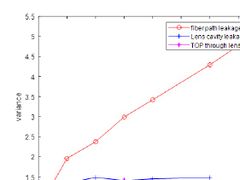
Leakage analysis is shown on the picture below. The conditions were set as follows: 1)Send Toptica laser through fiber into the science cavity and reflected into MBR BHD. This is what we usually did. (red circles). 2)Send MBR laser through EOM and lens cavity, and use the output(6.8GHz modulated) to MBR BHD. (blue plus) 3) Send Toptica laser through the lens cavity which serves as a filter, and into MBR BHD. (magenta stars)
- 250119 squeezing optical scheme.pdf
New experimental layout

We can conclude that the ECDL laser have noise on very high frequencies.
25th of January
New setup of alignment. Pump2 is generated by EOM + lens cavity. The frequency of Pump-1: MBR+59; of Pump-2: MBR+59+X = Toptica -59, previous locking point of toptica: Top-MBR = 6895 MHz  . New locking point for toptica: Top-MBR = 6895/96=71.83M. Strange features of the signal:
- Toptica signal is always lower than MBR signal, half of it at most.
- When we go closer or below threshold toptica disappears.
- We have strong dependence on pump1 and pump2 focusing properties.
- toptica signal scales the same as MBR, if we detune further we don't see toptica increase.
- two signals have different detunings, if we set "right" frequencies everywhere.
Possible explanations:
♠ toptica still misbehaves (we can lock it with both positive & negative setting of lock box)
♠ we are far away from resonance, so toptica doesn't increase.
♠ we didn't lock signal generator, which serves as a reference for toptica.
♠ Check the pump frequency on Toptica's homodyne
29th of January
- in pulsed regime AOM angle changes, so the fiber alignment can drop
Lens dependence
no lens <=> no toptica signal
250 mm <=> max 50% of MBR signal
31st of January
Data without leakage from toptica pump. Program is here:
February
13th of February
Pulsed regime. With a bright cloud, we have only strong MBR signal. With a weak cloud only toptica signal, and its signal increases as we come closer to resonance.
15th of February
We have seen two-three different regimes.
- At zero detuning, we have strong MBR signal.We have more or less balanced signal at 50-60 MHz.
We have found that toptica pump switches off incompletely, we fixed pulsed program in the dropbox folder.
16th of February
We thought of changing the roles of..
March-pulsed
4-6
7th of March
We have noticed that MBR channel is scanned, toptica has always constant amplitude. We try two differnent pulse durations: 200 ns and 500 ns with a repumper "on". We flipped AOMs modulation and saw the same scanning only in MBR channel.
12th of March
We had a thought that we have a strong seeding into the atoms, that is why we see modulated amplitude of pulses in one channel. We assumed that we seed by the first order of AOM. We noticed that opening and closing iris for a toptica pump beam makes a big difference to the signal. To minimize this effect we introduced two additional AOMs to modulate LO frequency independently.
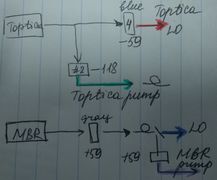
New experimental layout
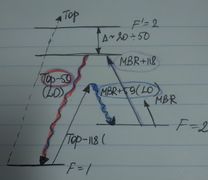
New scheme level
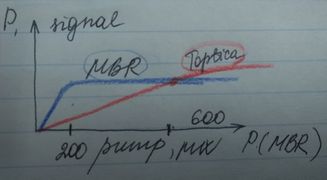
Dependence on MBR pump power of two signals in continuous regime


Continuous regime worked at higher MBR power 600 uW.
We have noticed that in the pulsed regime, we see maximum MBR signal at 29.23*233 MHz and maximum toptica signal at 29.48*233 MHz, theoretically we expect to see signal at 29.33*233 MHz.
13th of March
We were able to balance signals in the pulsed mode, although we don't see correlations. The atomic cloud was shifting later in a day, changing what we see.
20th of March
We made two experiments in order to find proper detunings:
I. We sent MBR pump pulses alternated with repumping. Adjusting values for EOM and YL locking frequency we achieved a train of pulses. The frequencies were set to:
| EOM | YL, lock | HFS | FSR | Detuning |
|---|---|---|---|---|
| 7010.14 | 29.142x233 | 6833 | 6870 | 20-40 |



II. We sent Toptica pumping pulses and cooling laser to bring the population back. Maximum MBR signal corresponded to 29.35x233 YL lock frequency. Although its frequency wasn't at zero.
 Where Δ X = ± (5 ÷ 50) MHz.
21st of March
We remeasured FSR of our cavity, it changed to 6880 MHz, so current values
