Difference between revisions of "Laser 606"
| (139 intermediate revisions by 2 users not shown) | |||
| Line 1: | Line 1: | ||
===Introduction=== | ===Introduction=== | ||
| + | There are not many laser sources in the orange part of visible spectrum. | ||
| + | |||
===Dye=== | ===Dye=== | ||
| − | === | + | [[File:DYE-SF-077-Scheme.png|thumb|500px|Principal scheme of the DYE-SF-077 laser]] |
| − | # '' | + | ====Tekhnoscan DYE-SF-077==== |
| + | |||
| + | While in principle the current dye laser should meet the criteria for Pr:YSO experiment, in practice few problems raised, that limits the functionality: | ||
| + | # The laser optomechanics is in band shape, that results in cross-coupling between screws for orthogonal degrees of freedom. | ||
| + | # Long term power drift occurs. Over an hour the power is reduced by 20-30%. The exact reason is unknown. The thoughts are | ||
| + | ## thermal drift of the MP1-2 or/and MP3 mirror | ||
| + | ## one's of the mirror spring unclenches | ||
| + | # Long term stabilization of the laser to the reference cavity was problematic due to short burst of frequency shift. We think the reason is air bubbles in the dye jet. We don't know how to handle the problem, except calling the manufacture for help. | ||
| + | # The spatial mode is far from TEM00, that results in extra loss for EOM and optical isolator | ||
| + | |||
| + | ===Commercial Solid State lasers=== | ||
| + | ====Toptica==== | ||
| + | For 606nm, a TA-SHG system is, indeed, the best option. We could provide >500mW of output power (before fiber coupling) at 606nm with 50kHz linewidth and 10GHz of mode-hop-free tuning. The base system is priced around '''$125-150k'''. This includes the low-noise digital controller, stable master ECDL, TA, Resonant SHG stage, and training and installation. | ||
| + | |||
| + | {| class="wikitable" | ||
| + | |- | ||
| + | ! style="text-align:left" | Item | ||
| + | ! Description | ||
| + | ! Price Listed | ||
| + | ! Price Discounted | ||
| + | |- | ||
| + | | DLC TA PRO | ||
| + | | Complete system TA PRO with digital DLC pro controller | ||
| + | | $48 280 | ||
| + | | $41 040 | ||
| + | |- | ||
| + | | OK-001116 | ||
| + | | Optical isolator 1150 - 1200 nm | ||
| + | | $7140 | ||
| + | | $6069 | ||
| + | |- | ||
| + | | SYST SHG PRO | ||
| + | | Stand-Alone Frequency Doubling Stage for CW Lasers | ||
| + | | $66 140 | ||
| + | | $56 220 | ||
| + | |} | ||
| + | |||
| + | ====MPB Communications==== | ||
| + | They sell under category single frequency lasers, which would consist of Raman fiber amplifier and a frequency doubler. We need to get our own seed at 1212nm in order to get 606nm output. They say that amplification options are 1W or 2W, with as little as 40 mW of seed. The frequency stabilization would be done by stabilizing the seed. | ||
| + | The price is in the range '''60-70k$''', and manufacturing times are 16-18 weeks. | ||
| + | |||
| + | ====PreciLasers (https://precilasers.com/) ==== | ||
| + | They sell single frequency Raman fiber amplifiers. The central wavelength range is 1100-1340 nm with output power up to 30W. Single amplifier only supports ±5nm tuning range. | ||
| + | |||
| + | Prices for 1212 nm amplifier. 10 W - $40k, 20 W - $60k, 30 W - $72k. | ||
| + | They also supply 606nm with output power of 4W and 10W. The RFA +SHG with 4W and 10W cost $58K and $88K, respectively | ||
| + | |||
| + | ==== Hubner photonics ==== | ||
| + | They sell an optical parametric oscillator (OPO) + SHG, that is capable of producing 300-400 mW visible light from 5W 532 nm pump (High power option). | ||
| + | The OPO is tunable in two region 450 - 525 nm and 540 - 650 nm with gap in 525-540 nm due to design constrain. | ||
| + | The principle scheme is below, the 532 nm photon is converted in two photons in OPO cavity with 1064+Δ nm and 1064-Δ nm, the former is send in SHG unit, where it is converted into 532-Δ/2. | ||
| + | By tuning crystal phase matching or OPO cavity it is possible to tune Δ wide and slow or faster in narrower spectral range. | ||
| + | |||
| + | Russian Quote was 21 700 000 RUB including 5W pump laser. It is '''$306k''' USD and it includes all Russian taxes (70%). Thus we presume that original price is '''$180-200k''' USD. | ||
| + | |||
| + | [[File:Hubner-OPO.PNG|center|thumb|500px| Principle scheme of OPO + SHG from Hubner photonics ]] | ||
| + | |||
| + | === Homemade DPSS === | ||
| + | Unfortunately, there are no widely available solid state laser in orange part of spectrum. In fact there are two options to handle this problem. We can shift the frequency of our laser to 606 nm by either four wave mixing (FWM) or second harmonic generation (SHG) depending on the available laser. However, there are few problems with this approach: | ||
| + | # SHG Non-linear process reduces power a lot. | ||
| + | # OPO may require both stable seed and pump lasers. | ||
| + | The other way is to generate the necessary wavelength by a proper laser gain medium. Obviously, we can use trivial praseodymium for generating orange light for praseodymium. It is interesting, that other rare-earth ion Samarium is also a candidate for 606 nm laser medium. | ||
| + | Both ions can be pumped by relatively cheap blue laser diode. Praseodymium ion absorbs light around ~445 nm and ~480 nm, while Samarium absorption band lies around 400 nm. | ||
| + | |||
| + | |||
| + | <gallery widths=400px heights=500px perrow=3> | ||
| + | Image:Diode-spectrum.PNG|The spectrum of the possible pumps: Laser diode @ 445 nm and second harmonic @ 480 nm. | ||
| + | Image:Pr-level.PNG| Level diagram free Pr ion | ||
| + | Image:Sm-levels.PNG| Level diagram free Sm ion | ||
| + | </gallery> | ||
| + | |||
| + | ==== <math>\text{Pr}^{+3}</math>-doped lasers ==== | ||
| + | The straight forward idea is to build our own laser out of praseodymium doped crystal or fiber. | ||
| + | It is possible to use either ZBLAN fiber doped with Pr ions or fluoride crystal namely LiYF. | ||
| + | |||
| + | ===== Pr:LiYF ===== | ||
| + | In general for constructing solid state crystal-based laser you need to address several laser issues: | ||
| + | # Something has to be done to suppress spatial hole-burning: the presence of cavity antinodes makes the gain to be modulated within the cavity. The effect can make it difficult to achieve single-frequency operation with standing-wave laser resonators, because the lasing mode experiences stronger gain saturation than competing non-lasing modes. [https://www.rp-photonics.com/spatial_hole_burning.html More details can be found at RP Photonics]. Conventional way to handle this problem is '''ring cavity configuration'''. | ||
| + | # good pump beam quality. Poor pump mode may spoil the lasing mode, since the overlap between the laser cavity and pumping mode is crucial for achieving high power. | ||
| + | # Thermal management: At high power crystal tends to heat up and thus changing its refracting index. If temperature distribution is non-uniform, so-called thermal lensing occurs. It may destroy alignment of the cavity or at least shift its frequency. Usually this problem is solved by application of water-cooling to the crystal. The problem is especially relevant for so-called fluoride crystals including LiYF, because they tends to heat much faster. | ||
| + | |||
| + | Several Pr:LiYF laser has been constructed by different groups. We have selected few examples: | ||
| + | # Several hundreds of mW has been achieved at 607 nm by [https://doi.org/10.1364/OL.36.001002 Gün, Metz, and Huber]. They used two GaN LD with a total power of 1.5 W to pump the crystal from opposite directions. | ||
| + | # After that ~3.5 Watt Pr:LiYF laser at 607 nm was demonstrated by [https://doi.org/10.1364/AO.57.005923 Tanaka, Fujita, and Fumihiko Kannari]. Here authors insted of diodes used 4 combing each pair on polarization beam splitter. | ||
| + | |||
| + | In both case the laser cavity was Fabry-Perot type of cavity consisted from dichronic mirror, that transmits blue and reflects orange and red wavelength. | ||
| + | [[File:PrYLiF-laser-2D.PNG|center|thumb|500px|An example of PrYLiF laser in Fabry-Perot cavity]] | ||
| + | |||
| + | ===== Pr:ZBLAN ===== | ||
| + | The alternative solution is to use ZBLAN fiber with Praseodymium ions. | ||
| + | Few experiments showed that praseodymium doped ZBLAN is capable of lasing: | ||
| + | |||
| + | Tunable laser was demonstrated by [https://www.osapublishing.org/oe/fulltext.cfm?uri=oe-17-22-20227&id=187248 Okamoto, Kasuga, Hara, and Kubota ] in wavelength range (479–497, | ||
| + | 515–548, 597–737, 849-960 nm). They used 9-cm SM Fiber with Pr concentration of 3000 wt-ppm having a core diameter of 3.8–3.9 μm, cladding diameter of 125 μm, and numerical aperture of 0.22. | ||
| + | As the result several tens of mW power was achieve. The fiber was cleaved at 10<sup>o</sup> Degree to reduce the losses. | ||
| + | From one side of the fiber an optical prism spectrally select emission from the fiber and sends it on the broadband mirror. From the other side dichronic mirror is used to reflect laser emission back into the cavity, while transmitting pump from multimode laser diode operating at 444 nm. | ||
| + | |||
| + | <gallery widths=300px heights=400px perrow=3> | ||
| + | Image:Pr-ZBLAN-schematic.PNG|Experimental setup of 9-cm Pr:ZBLAN laser | ||
| + | Image:9cm-ZBLAN-power.PNG| Slope efficiency of lasing at different wavelenght | ||
| + | </gallery> | ||
| + | |||
| + | |||
| + | Lately watt-level lasing was demonstrated by [https://www.osapublishing.org/oe/fulltext.cfm?uri=oe-17-22-20227&id=187248 Kifle et. all] in 5m double-clad fiber. | ||
| + | Double-clad fiber allows lasing mode to propagate in single mode regime, while pump in multimode. It allows to increase pumping power up to several watts without damaging the fiber end. | ||
| + | Authors used a Pr<sup>3+</sup>-doped ZBLAN fluoride fiber (Le Verre Fluoré) in the double-clad geometry. The doping | ||
| + | level was 0.6 mol.% PrF<sub>3</sub> (NPr D 1.16 10<sup>20</sup> cm<sup>3</sup>). The core diameter was 5.5 μm, and the inner cladding made of a lowerindex fluoride glass had a truncated circular (double D-shaped) profile with diameters of 115/125 μm used to enhance the pump absorption. The outer cladding made of a resin polymer had a diameter of 180 μm. | ||
| + | |||
| + | Meanwhile the lasing mode is propogating in single mode regime and has almost diffraction limited profile. The observed M<big>2</big> factor was 1.1. | ||
| + | |||
| + | <gallery widths=300px heights=400px perrow=3> | ||
| + | Image:5m-ZBLAN.PNG| Experimental setup of 5-m Pr:ZBLAN double-clad fiber laser | ||
| + | Image:DoubleCladFiber.PNG| View of DoubleClad fiber | ||
| + | </gallery> | ||
| + | |||
| + | ==== Thoughts on Pr:ZBLAN design ==== | ||
| + | The so-called Master Oscillator Power Amplifier (MOPA) design where a small laser together with amplifier seems the most reasonable solution for stable and high power fiber laser @ 606 nm. | ||
| + | |||
| + | In this case small fiber laser with small cavity and hence large FSR would dumps mode-hoping and would operate in single frequency regime. | ||
| + | |||
| + | This laser may provide power of several tens of miliwatt. The further increase to a watt level may be done with help of an amplifier, that is composed from the same longer fiber. | ||
| + | |||
| + | We thought on two design. | ||
| + | |||
| + | ===== Volume bragg grating based ===== | ||
| + | |||
| + | Use of volume bragg grating may create a laser mirror cavity in a very narrow spectral range (10-50 GHz) around 606 nm. | ||
| + | |||
| + | Thus single frequency regime can be easily achieved if FSR of the obtained laser cavity is comparable to this value. | ||
| + | |||
| + | Alternative if FSR is significantly smaller than the VBG bandwith | ||
| + | extra "etalon" may be required. | ||
| + | |||
| + | This "etalon" may be just a internal reflective element (dichroic mirror?), that composed an extra cavity. | ||
| + | |||
| + | The sketch of the design is presented below. | ||
| + | |||
| + | [[File:Pr-ZBLAN-Laser-design.png|center|thumb|500px| Concept of VBG Pr:ZBLAN laser]] | ||
| + | |||
| + | '''Pros:''' | ||
| + | |||
| + | + VBG provides laser stability and introduces small losses | ||
| + | |||
| + | + single frequency regime is easy to achieve | ||
| + | |||
| + | '''Cons:''' | ||
| + | |||
| + | - VBG with given properties costs around $5000 | ||
| + | |||
| + | - Wavelength tunability is lost | ||
| + | |||
| + | ===== Diffraction grating grating based ===== | ||
| + | |||
| + | The alternative design is based on conventional diffraction grating (DG), which resembles popular external cavity laser diode Littlow-Littman designs. | ||
| + | |||
| + | Here DG plays two roles: | ||
| + | |||
| + | First it separates pump @ 445 nm from the 606 nm emission. | ||
| + | |||
| + | Secondly and most importantly it composes a laser cavity for 606 nm by sending a first order diffraction on broadband mirror. | ||
| + | |||
| + | The DG brings a benefit of wide wavelength tunability as rotating DG changes the frequency of the emission that is resonant to laser cavity. | ||
| + | |||
| + | [[File:Pr-ZBLAN-Laser-design-2.png|center|thumb|500px| Concept of External cavity Pr:ZBLAN laser]] | ||
| + | |||
| + | '''Pros:''' | ||
| + | |||
| + | + DG gives much larger tunability, than VBG. | ||
| + | |||
| + | + DG is cheap and costs around $200. | ||
| + | |||
| + | '''Cons:''' | ||
| + | |||
| + | - DG is less efficient than VBG as it reflects into first order no more than 80% compare to more than 95% for VBG, that would probably require longer fiber or more powerful pump. | ||
| + | |||
| + | - Single frequency operation would be more difficult to achieve in this design as mode hopes may occur. | ||
| + | |||
| + | - Grating stabilization in addition to extra spectral filter may be required | ||
| + | |||
| + | ===== Optical amplifier ===== | ||
| + | Optical amplifier seems the most straightforward element as it is composed from longer Pr:ZBLAN fiber, 606-nm AR-coated coupling optics and set of dichroic mirrors, that separate pump from the amplified emission. | ||
| + | While the design is conceptually simple, care should be taken with choice of fiber length and pump power as probably there is an optimum power for given fiber length. | ||
| + | |||
| + | Beforehand a numerical simulation may be required. | ||
| + | |||
| + | [[File:Pr-ZBLAN-amplifier-design.png|center|thumb|500px| Concept of Pr:ZBLAN amplifier ]] | ||
| − | + | ==== <math>Sm^{+3}</math>-doped lasers ==== | |
| + | {{highlight|text|red}} | ||
| − | + | [[Category:Praseodymium]][[Category:Laser]] | |
Latest revision as of 06:25, 26 November 2021
Introduction
There are not many laser sources in the orange part of visible spectrum.
Dye

Tekhnoscan DYE-SF-077
While in principle the current dye laser should meet the criteria for Pr:YSO experiment, in practice few problems raised, that limits the functionality:
- The laser optomechanics is in band shape, that results in cross-coupling between screws for orthogonal degrees of freedom.
- Long term power drift occurs. Over an hour the power is reduced by 20-30%. The exact reason is unknown. The thoughts are
- thermal drift of the MP1-2 or/and MP3 mirror
- one's of the mirror spring unclenches
- Long term stabilization of the laser to the reference cavity was problematic due to short burst of frequency shift. We think the reason is air bubbles in the dye jet. We don't know how to handle the problem, except calling the manufacture for help.
- The spatial mode is far from TEM00, that results in extra loss for EOM and optical isolator
Commercial Solid State lasers
Toptica
For 606nm, a TA-SHG system is, indeed, the best option. We could provide >500mW of output power (before fiber coupling) at 606nm with 50kHz linewidth and 10GHz of mode-hop-free tuning. The base system is priced around $125-150k. This includes the low-noise digital controller, stable master ECDL, TA, Resonant SHG stage, and training and installation.
| Item | Description | Price Listed | Price Discounted |
|---|---|---|---|
| DLC TA PRO | Complete system TA PRO with digital DLC pro controller | $48 280 | $41 040 |
| OK-001116 | Optical isolator 1150 - 1200 nm | $7140 | $6069 |
| SYST SHG PRO | Stand-Alone Frequency Doubling Stage for CW Lasers | $66 140 | $56 220 |
MPB Communications
They sell under category single frequency lasers, which would consist of Raman fiber amplifier and a frequency doubler. We need to get our own seed at 1212nm in order to get 606nm output. They say that amplification options are 1W or 2W, with as little as 40 mW of seed. The frequency stabilization would be done by stabilizing the seed. The price is in the range 60-70k$, and manufacturing times are 16-18 weeks.
PreciLasers (https://precilasers.com/)
They sell single frequency Raman fiber amplifiers. The central wavelength range is 1100-1340 nm with output power up to 30W. Single amplifier only supports ±5nm tuning range.
Prices for 1212 nm amplifier. 10 W - $40k, 20 W - $60k, 30 W - $72k. They also supply 606nm with output power of 4W and 10W. The RFA +SHG with 4W and 10W cost $58K and $88K, respectively
Hubner photonics
They sell an optical parametric oscillator (OPO) + SHG, that is capable of producing 300-400 mW visible light from 5W 532 nm pump (High power option). The OPO is tunable in two region 450 - 525 nm and 540 - 650 nm with gap in 525-540 nm due to design constrain. The principle scheme is below, the 532 nm photon is converted in two photons in OPO cavity with 1064+Δ nm and 1064-Δ nm, the former is send in SHG unit, where it is converted into 532-Δ/2. By tuning crystal phase matching or OPO cavity it is possible to tune Δ wide and slow or faster in narrower spectral range.
Russian Quote was 21 700 000 RUB including 5W pump laser. It is $306k USD and it includes all Russian taxes (70%). Thus we presume that original price is $180-200k USD.

Homemade DPSS
Unfortunately, there are no widely available solid state laser in orange part of spectrum. In fact there are two options to handle this problem. We can shift the frequency of our laser to 606 nm by either four wave mixing (FWM) or second harmonic generation (SHG) depending on the available laser. However, there are few problems with this approach:
- SHG Non-linear process reduces power a lot.
- OPO may require both stable seed and pump lasers.
The other way is to generate the necessary wavelength by a proper laser gain medium. Obviously, we can use trivial praseodymium for generating orange light for praseodymium. It is interesting, that other rare-earth ion Samarium is also a candidate for 606 nm laser medium. Both ions can be pumped by relatively cheap blue laser diode. Praseodymium ion absorbs light around ~445 nm and ~480 nm, while Samarium absorption band lies around 400 nm.
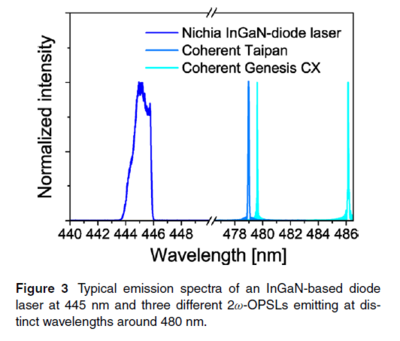
The spectrum of the possible pumps: Laser diode @ 445 nm and second harmonic @ 480 nm.
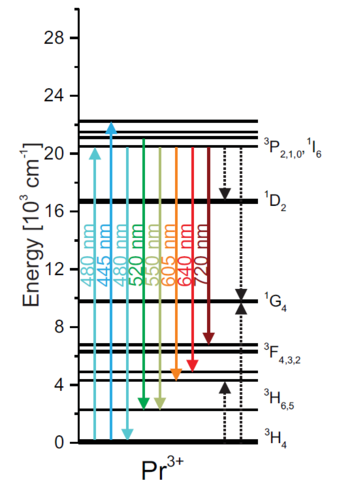
Level diagram free Pr ion
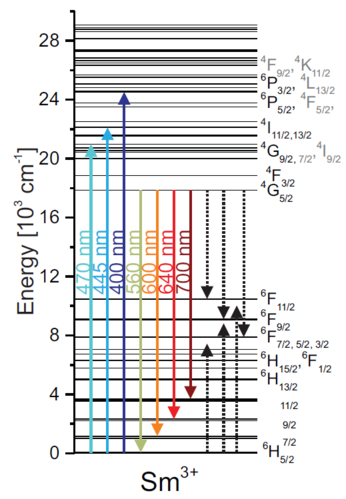
Level diagram free Sm ion


 -doped lasers
The straight forward idea is to build our own laser out of praseodymium doped crystal or fiber. It is possible to use either ZBLAN fiber doped with Pr ions or fluoride crystal namely LiYF.
Pr:LiYF
In general for constructing solid state crystal-based laser you need to address several laser issues:
- Something has to be done to suppress spatial hole-burning: the presence of cavity antinodes makes the gain to be modulated within the cavity. The effect can make it difficult to achieve single-frequency operation with standing-wave laser resonators, because the lasing mode experiences stronger gain saturation than competing non-lasing modes. More details can be found at RP Photonics. Conventional way to handle this problem is ring cavity configuration.
- good pump beam quality. Poor pump mode may spoil the lasing mode, since the overlap between the laser cavity and pumping mode is crucial for achieving high power.
- Thermal management: At high power crystal tends to heat up and thus changing its refracting index. If temperature distribution is non-uniform, so-called thermal lensing occurs. It may destroy alignment of the cavity or at least shift its frequency. Usually this problem is solved by application of water-cooling to the crystal. The problem is especially relevant for so-called fluoride crystals including LiYF, because they tends to heat much faster.
Several Pr:LiYF laser has been constructed by different groups. We have selected few examples:
- Several hundreds of mW has been achieved at 607 nm by Gün, Metz, and Huber. They used two GaN LD with a total power of 1.5 W to pump the crystal from opposite directions.
- After that ~3.5 Watt Pr:LiYF laser at 607 nm was demonstrated by Tanaka, Fujita, and Fumihiko Kannari. Here authors insted of diodes used 4 combing each pair on polarization beam splitter.
In both case the laser cavity was Fabry-Perot type of cavity consisted from dichronic mirror, that transmits blue and reflects orange and red wavelength.

Pr:ZBLAN
The alternative solution is to use ZBLAN fiber with Praseodymium ions. Few experiments showed that praseodymium doped ZBLAN is capable of lasing:
Tunable laser was demonstrated by Okamoto, Kasuga, Hara, and Kubota in wavelength range (479–497, 515–548, 597–737, 849-960 nm). They used 9-cm SM Fiber with Pr concentration of 3000 wt-ppm having a core diameter of 3.8–3.9 μm, cladding diameter of 125 μm, and numerical aperture of 0.22. As the result several tens of mW power was achieve. The fiber was cleaved at 10o Degree to reduce the losses. From one side of the fiber an optical prism spectrally select emission from the fiber and sends it on the broadband mirror. From the other side dichronic mirror is used to reflect laser emission back into the cavity, while transmitting pump from multimode laser diode operating at 444 nm.

Experimental setup of 9-cm Pr:ZBLAN laser

Slope efficiency of lasing at different wavelenght


Lately watt-level lasing was demonstrated by Kifle et. all in 5m double-clad fiber.
Double-clad fiber allows lasing mode to propagate in single mode regime, while pump in multimode. It allows to increase pumping power up to several watts without damaging the fiber end.
Authors used a Pr3+-doped ZBLAN fluoride fiber (Le Verre Fluoré) in the double-clad geometry. The doping
level was 0.6 mol.% PrF3 (NPr D 1.16 1020 cm3). The core diameter was 5.5 μm, and the inner cladding made of a lowerindex fluoride glass had a truncated circular (double D-shaped) profile with diameters of 115/125 μm used to enhance the pump absorption. The outer cladding made of a resin polymer had a diameter of 180 μm.
Meanwhile the lasing mode is propogating in single mode regime and has almost diffraction limited profile. The observed M2 factor was 1.1.
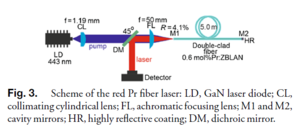
Experimental setup of 5-m Pr:ZBLAN double-clad fiber laser
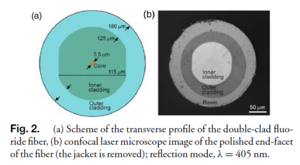
View of DoubleClad fiber


Thoughts on Pr:ZBLAN design
The so-called Master Oscillator Power Amplifier (MOPA) design where a small laser together with amplifier seems the most reasonable solution for stable and high power fiber laser @ 606 nm.
In this case small fiber laser with small cavity and hence large FSR would dumps mode-hoping and would operate in single frequency regime.
This laser may provide power of several tens of miliwatt. The further increase to a watt level may be done with help of an amplifier, that is composed from the same longer fiber.
We thought on two design.
Volume bragg grating based
Use of volume bragg grating may create a laser mirror cavity in a very narrow spectral range (10-50 GHz) around 606 nm.
Thus single frequency regime can be easily achieved if FSR of the obtained laser cavity is comparable to this value.
Alternative if FSR is significantly smaller than the VBG bandwith extra "etalon" may be required.
This "etalon" may be just a internal reflective element (dichroic mirror?), that composed an extra cavity.
The sketch of the design is presented below.

Pros:
+ VBG provides laser stability and introduces small losses
+ single frequency regime is easy to achieve
Cons:
- VBG with given properties costs around $5000
- Wavelength tunability is lost
Diffraction grating grating based
The alternative design is based on conventional diffraction grating (DG), which resembles popular external cavity laser diode Littlow-Littman designs.
Here DG plays two roles:
First it separates pump @ 445 nm from the 606 nm emission.
Secondly and most importantly it composes a laser cavity for 606 nm by sending a first order diffraction on broadband mirror.
The DG brings a benefit of wide wavelength tunability as rotating DG changes the frequency of the emission that is resonant to laser cavity.

Pros:
+ DG gives much larger tunability, than VBG.
+ DG is cheap and costs around $200.
Cons:
- DG is less efficient than VBG as it reflects into first order no more than 80% compare to more than 95% for VBG, that would probably require longer fiber or more powerful pump.
- Single frequency operation would be more difficult to achieve in this design as mode hopes may occur.
- Grating stabilization in addition to extra spectral filter may be required
Optical amplifier
Optical amplifier seems the most straightforward element as it is composed from longer Pr:ZBLAN fiber, 606-nm AR-coated coupling optics and set of dichroic mirrors, that separate pump from the amplified emission. While the design is conceptually simple, care should be taken with choice of fiber length and pump power as probably there is an optimum power for given fiber length.
Beforehand a numerical simulation may be required.

 -doped lasers
text
