Difference between revisions of "Laser 606"
| Line 57: | Line 57: | ||
<gallery> | <gallery> | ||
File:Diode-spectrum.PNG| The spectrum of the possible pumps: Laser diode @ 445 nm and second harmonic @ 480 nm. | File:Diode-spectrum.PNG| The spectrum of the possible pumps: Laser diode @ 445 nm and second harmonic @ 480 nm. | ||
| − | File: | + | File:Pr-level.PNG| Pr Level diagram] |
File:SAES_dispenser.png|alt=An example image. It has flowers | File:SAES_dispenser.png|alt=An example image. It has flowers | ||
| − | |||
| − | |||
</gallery> | </gallery> | ||
Revision as of 09:30, 28 July 2021
Contents
Introduction
There are not many laser sources in the orange part of visible spectrum.
Dye

Tekhnoscan DYE-SF-077
While in principle the current dye laser should meet the criteria for Pr:YSO experiment, in practice few problems raised, that limits the functionality:
- The laser optomechanics is in band shape, that results in cross-coupling between screws for orthogonal degrees of freedom.
- Long term power drift occurs. Over an hour the power is reduced by 20-30%. The exact reason is unknown. The thoughts are
- thermal drift of the MP1-2 or/and MP3 mirror
- one's of the mirror spring unclenches
- Long term stabilization of the laser to the reference cavity was problematic due to short burst of frequency shift. We think the reason is air bubbles in the dye jet. We don't know how to handle the problem, except calling the manufacture for help.
- The spatial mode is far from TEM00, that results in extra loss for EOM and optical isolator
Commercial Solid State lasers
Toptica
For 606nm, a TA-SHG system is, indeed, the best option. We could provide >500mW of output power (before fiber coupling) at 606nm with 50kHz linewidth and 10GHz of mode-hop-free tuning. The base system is priced around $125-150k. This includes the low-noise digital controller, stable master ECDL, TA, Resonant SHG stage, and training and installation.
| Item | Description | Price Listed | Price Discounted |
|---|---|---|---|
| DLC TA PRO | Complete system TA PRO with digital DLC pro controller | $48 280 | $41 040 |
| OK-001116 | Optical isolator 1150 - 1200 nm | $7140 | $6069 |
| SYST SHG PRO | Stand-Alone Frequency Doubling Stage for CW Lasers | $66 140 | $56 220 |
MPB Communications
They sell under category single frequency lasers, which would consist of Raman fiber amplifier and a frequency doubler. We need to get our own seed at 1212nm in order to get 606nm output. They say that amplification options are 1W or 2W, with as little as 40 mW of seed. The frequency stabilization would be done by stabilizing the seed. The price is in the range 60-70k$, and manufacturing times are 16-18 weeks.
Homemade DPSS
Unfortunately, there are no widely available solid state laser in orange part of spectrum. In fact there are two options to handle this problem. We can shift the frequency of our laser to 606 nm by either four wave mixing (FWM) or second harmonic generation (SHG) depending on the available laser. However, there are few problems with this approach:
- SHG Non-linear process reduces power a lot.
- OPO may require both stable seed and pump lasers.
The other way is to generate the necessary wavelength by a proper laser gain medium. Obviously, we can use trivalent praseodymium for generating light orange light for praseodymium. It is interesting, that the other rare-earth ion Samarium is also a candidate for 606 nm laser medium. Both ions can be pumped by relatively cheap blue laser diode. Praseodymium ion absorbs light around ~445 nm and ~480 nm, while Samarium absorption band lies around 400 nm.

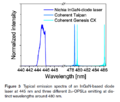
The spectrum of the possible pumps: Laser diode @ 445 nm and second harmonic @ 480 nm.
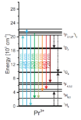
Pr Level diagram]


 -doped lasers
The straight forward idea is to build our own laser out of praseodymium doped crystal or fiber.
 -doped lasers