DLCZ articles
Contents
- 1 2018
- 2 2017
- 3 Jian-Wei Pan
- 3.1 "A millisecond quantum memory for scalable quantum networks" december 2008
- 3.2 Efficient and long-lived quantum memory with cold atoms inside a ring cavity, May 2012
- 3.3 "Highly Retrievable Spin-Wave–Photon Entanglement Source", May 2015
- 3.4 "An efficient quantum light-matter interface with sub-second lifetime" november 2015
- 3.5 "An efficient quantum light–matter interface with sub-second lifetime" april 2016
- 4 List of cites
- 5 Grangier
- 6 Riedmatten
- 7 Kuzmich
- 8 Polzic and Sorensen
- 9 DLCZ-like repeater protocols
2018
"Experimental entanglement of 25 individually accessible atomic quantum interfaces" Duan, DOI: 10.1126/sciadv.aar3931
"Remote quantum entanglement between two micromechanical oscillators" Gröblacher, Nature volume 556, pages473–477 (2018)
"Entanglement between a Photonic Time-Bin Qubit and a Collective Atomic Spin Excitation" Riedmatten, PRL 120, 100501 (2018)
2017
- "Photonic quantum state transfer between a cold atomic gas and a crystal" Nicolas Maring, Pau Farrera, Kutlu Kutluer, Margherita Mazzera, Georg Heinze1 & Hugues de Riedmatten
Jian-Wei Pan
"A millisecond quantum memory for scalable quantum networks" december 2008
They extend the storage time of quantum memory for single excitations to 1 ms. Techniques:
- clock states (or the first-order magnetic-field insensitive fields, be insensitive to residual magnetic field)
- long-wavelength spin wave (suppression of dephasing)
- ensemble of Rb 87 100uK
Uses states  . Conditional on detecting of write photon, a collective excited state or spin wave is imprinted on the atomic ensemble:
 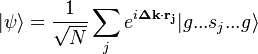 , where
  the wavevector of the spin wave. They investigated the dephasing of the spin wave induced by atomic motion.
"The dephasing can be understood as follows. As shown in Fig. 1c, assume a SW is stored in the atomic ensemble and will be retrieved out after a time delay δt.
During this interval, each atom randomly moves from one point to another. The internal states or the spin of the atoms are conserved since collisions can be safely neglected at a low temperature and density. However, the atomic motion leads to a perturbation on the phase of the SW. Consequently, the projection of the perturbed SW on the original one gradually decreases as the delay of the retrieve is increased. In other words, the atomic random motion leads to a random phase fluctuation in the SW and thus causes decoherence. The timescale of the dephasing can be estimated by calculating the average time needed for the atoms to cross 1/2π of the wavelength of the SW, giving a lifetime of
the wavevector of the spin wave. They investigated the dephasing of the spin wave induced by atomic motion.
"The dephasing can be understood as follows. As shown in Fig. 1c, assume a SW is stored in the atomic ensemble and will be retrieved out after a time delay δt.
During this interval, each atom randomly moves from one point to another. The internal states or the spin of the atoms are conserved since collisions can be safely neglected at a low temperature and density. However, the atomic motion leads to a perturbation on the phase of the SW. Consequently, the projection of the perturbed SW on the original one gradually decreases as the delay of the retrieve is increased. In other words, the atomic random motion leads to a random phase fluctuation in the SW and thus causes decoherence. The timescale of the dephasing can be estimated by calculating the average time needed for the atoms to cross 1/2π of the wavelength of the SW, giving a lifetime of  , with
 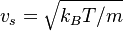 the one dimensional average speed,
  A more detailed calculation with the lifetime
  there is an angle θ=3 between k W and k S , and thus we have
  . For θ = 3 ◦ ,
  and
and  . In collinear configuration (theta=0), the maximal wavelength of the spin wave is
Efficient and long-lived quantum memory with cold atoms inside a ring cavity, May 2012
"Highly Retrievable Spin-Wave–Photon Entanglement Source", May 2015
They report a source of highly retrievable spin-wave–photon entanglement. Polarization entanglement is created through interaction of a single photon with an ensemble of atoms inside a low-finesse ring cavity. The cavity is engineered to be resonant for dual spin-wave modes, which thus enables efficient retrieval of the spin-wave qubit. An intrinsic retrieval efficiency up to 76(4)% has been observed. 1/e lifetime is 25.2(4) us. Techniques:
- Rb 87 20uK
- Low finesse cavity F=18
- angle between the cavity mode and write/read direction is 2.5 ◦
"An efficient quantum light-matter interface with sub-second lifetime" november 2015
An article published on ArXiv:1511.00407v1 "An efficient quantum light-matter interface with sub-second lifetime". They achieved an initial retrieval efficiency of 76.5% with an 1/e lifetime of 0.22 s. Techniques used:
- 3D optical lattice (limits atomic motion => suppresses motion-induced decoherence)
- atomic ensemble inside ring-cavity (increases the retrieval efficiency)
- magic trap (to compensate the lattice induced differential light shift)
Experimental setup consists of ensemble of Rb 87 atoms cooled down to 12 uK, the lattice-trapped ensemble is 0.2 mm wide and 0.8 mm long. Optical depth is 1.6 in z direction.
"An efficient quantum light–matter interface with sub-second lifetime" april 2016
List of cites
- ArXiv:1511.00407v1 "An efficient quantum light-matter interface with sub-second lifetime" November 2015
- PRL 114, 210501 "Highly Retrievable Spin-Wave–Photon Entanglement Source", May 2015
- ArXiv:1501.06278v1 Operating Spin Echo in the Quantum Regime for an Atomic-Ensemble Quantum Memory", January 2015
- DOI:10.1038/NPHYS2324 "Efficient and long-lived quantum memory with cold atoms inside a ring cavity" May 2012
- DOI:10.1038/nphys1153 "A millisecond quantum memory for scalable quantum networks" December 2008
Grangier
- Homodyne tomography of a single photon retrieved on demand from a cavity-enhanced cold atom memory
Riedmatten
Generation of single photons with highly tunable wave shape from a cold atomic quantum memory, january 2016
Around  atoms of 87 Rb are loaded into the MOT and cooled with long optical molasses 1.6 ms, optical depth is 5.5. The spin-wave is generated by sending a write pulse of 15 ns duration (FWHM). The heralded photon is collected at an angle 1 degree with respect to the write/ read pulse axis. The raw retrieval efficiency is defined as
 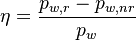 , where pwr is the probability of coincidence of detection of read and write photon, p_wnr probability to detect a coincidence due to background noise, pw probab to detect a write photon per trial.
To generate read photons of variable length, we change the duration of the Gaussian-shaped read pulse as well as the storage time over several orders of magnitude. The lower limit of photon duration is given by the limited optical depth OD=5.5 in our experiment which leads to limited superradiant emission of the read photon [40], i.e. a much faster emission than the decay time of the excited state of approximately 27 ns. The upper limit of photon duration is given by the spin-wave linewidth which is mainly determined by thermal motion of the atoms and spurious external magnetic fields. This currently limits the maximal storage time in the memory of about 60μs, cf. supplemental material [41]. The photon duration will also be limited by the coherence time of the read laser which has a specified linewidth of 20 kHz.
They characterized the state of the emitted read photons by measuring their heralded and unheralded second order autocorrelation functions depending on the read photon duration. Autocorrelation function : 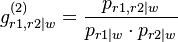 , for perfect single photons
  , nonclassicality of the photons
The purity of the photon state is characterized by the unconditional autocorrelation function  For an ideal two mode squeezed state, where the write and read photons are each emitted in a single temporal mode, one expects
They investigate the flexibility of the temporal wave shape of the generated read photons. Instead of a Gaussian shaped read pulse we send read pulses with a rising exponential envelope and a doubly peaked wave shape into the cloud. Photons with rising exponential wave shape exhibit the highest possible absorbance when interacting with two-level systems [34, 48] and can be very efficiently loaded in optical cavities [35, 49]. Photons with a delocalized shape (doubly peaked) can be used to create time-bin qubits which have applications in robust long distance quantum communication [50, 51].
Controlled rephasing of single collective spin excitations in a cold atomic quantum memory, January 2015
An important step towards the implementation of a functional temporally multiplexed quantum repeater node.
Temporally multiplexed quantum repeaters with atomic gases (2010)
- arXiv:1601.07142v1 Generation of single photons with highly tunable wave shape from a cold atomic quantum memory, January 2016
- Precision requirements for spin-echo based quantum memories
- Prospective applications of optical quantum memories
- arXiv:1501.07559v1 Controlled rephasing of single collective spin excitations in a cold atomic quantum memory, January 2015
- C. Simon, H. de Riedmatten, and M. Afzelius, Phys. Rev. A 82, 010304 (2010)
Kuzmich
Polzic and Sorensen
Key words: room temperature atoms, spin-protecting coating, discrete variables, quantum memory, optical cavity [1]
"we introduce room temperature microcells as a system for discrete variable, ensemble-based quantum information processing. We show theoretically how the detrimental effect of atomic motion can be circumvented in order to have an efficient and coherent interaction between an atomic ensemble and light at the single-photon level."
