Topology
Jump to navigation
Jump to search
Spielman's review.
Berry phase
Direct measurement of the Zak phase in topological Bloch bands
They work with 1D dimerized optical lattice (or as they call it a superlattice), which leads to the Rice-Mele Hamiltonian:
 . If Δ is tuned to be equal then the system corresponds to the Su-Schrieffer-Heeger (SSH) model, which has two topologically distinct phases. The Zak phase difference between them is equal to π. The Zak phase is a gauge dependent quality, although the Zak phase difference of the two dimerizations is uniquely defined. Total phase obtained by a particle moved through the Brillouin zone has three contributions: geometric phase (Zak), dynamical phase (
 ), and a phase due to Zeeman energy.
Experimental procedure
- By conrolling phase between two standing-wave lasers they were able to tune across phase transition.
- prepare atoms in |↓, k=0> state
- apply a π/2 pulse to have a superposition of ↑ and ↓,
- the force created by the gradient of a magnetic field acts in opposite directions on two spins, thus superposition evolves into

- To eliminate Zeeman phase from the measurement a spin-echo π is applied, D1 changed to D2
- Spins evolve in the upper band, until they return to k=0
- π/2 is applied to interfere two spin components, the final phase measured is φ(Zak, D1)-φ(Zak, D2)
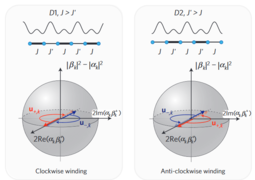
A. Two phases
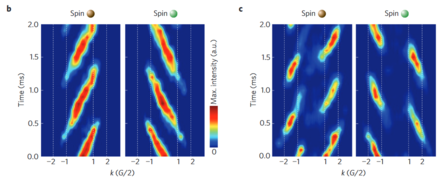
B. Phases measurement


