Difference between revisions of "Topology"
Jump to navigation
Jump to search
| Line 4: | Line 4: | ||
They work with 1D dimerized optical lattice, which leads to the Rice-Mele Hamiltonian: | They work with 1D dimerized optical lattice, which leads to the Rice-Mele Hamiltonian: | ||
<math>\bar H = -\sum_n(Ja^\dagger_n b_n+J'a^\dagger b_{n-1}+\text{h.c.})+\Delta\sum_n(a^\dagger_n a_n-b^\dagger_n b_n)</math>. If Δ is tuned to be equal then the system corresponds to the Su-Schrieffer-Heeger model. | <math>\bar H = -\sum_n(Ja^\dagger_n b_n+J'a^\dagger b_{n-1}+\text{h.c.})+\Delta\sum_n(a^\dagger_n a_n-b^\dagger_n b_n)</math>. If Δ is tuned to be equal then the system corresponds to the Su-Schrieffer-Heeger model. | ||
| + | <gallery mode="packed-hover"> | ||
| + | File:Berry 20200224 1.PNG | Experiment simplified | ||
| + | </gallery> | ||
[[Category:BEC]] | [[Category:BEC]] | ||
Revision as of 17:22, 24 February 2020
Spielman's review.
Berry phase
Direct measurement of the Zak phase in topological Bloch bands
They work with 1D dimerized optical lattice, which leads to the Rice-Mele Hamiltonian:
 . If Δ is tuned to be equal then the system corresponds to the Su-Schrieffer-Heeger model.
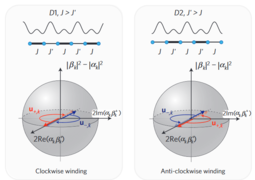
Experiment simplified

